
Introduction
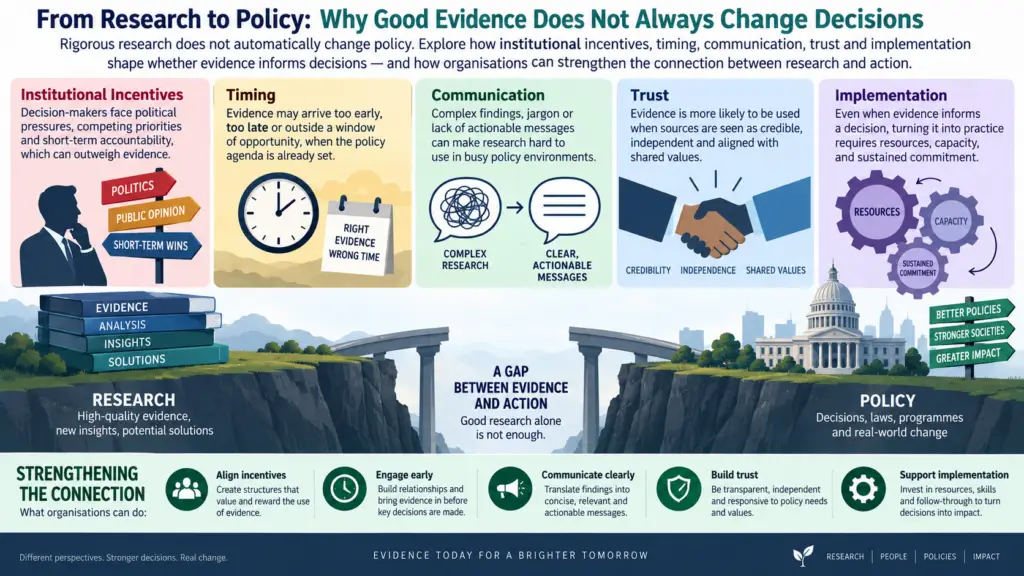
Research can identify a serious problem, demonstrate that an intervention produces results, or reveal that an established policy is not working as intended. Yet even strong evidence may have little influence on the decisions that matter.
A study may be technically rigorous and still remain unread. An evaluation may identify practical recommendations that are never implemented. A policy brief may present compelling findings without changing budget allocations, institutional priorities or service delivery.
This gap between generating evidence and influencing decisions is one of the persistent challenges in research, development and public policy.
The problem is not always that decision-makers disregard evidence. Research enters decision-making environments shaped by competing priorities, institutional incentives, political considerations, resource constraints and established ways of working. Evidence must operate within these environments if it is to inform meaningful change.
Understanding this requires moving beyond the assumption that better research automatically produces better policy.
1. Evidence informs decisions, but it rarely makes them alone
Policy decisions involve more than determining what the evidence says.
Decision-makers may need to balance effectiveness, affordability, equity, public acceptability, legal obligations and implementation capacity. Different groups may also disagree about which objectives deserve the greatest priority.
Consider an evaluation showing that a particular service-delivery model improves access for underserved communities. The findings may be convincing, but expanding the model could require additional personnel, changes to procurement arrangements, revised funding allocations or coordination across government departments.
The evidence may establish that the intervention is promising. It does not, by itself, resolve every question about how expansion should be financed, who should be responsible or which competing priorities should receive less funding.
This distinction is fundamental.
Research can clarify the likely consequences of different choices, identify uncertainty and challenge unsupported assumptions. However, decisions also involve values, interests and judgements about acceptable trade-offs.
Evidence-informed policy therefore does not mean allowing research findings to dictate every decision. It means ensuring that decisions engage seriously with relevant evidence, make assumptions explicit and explain how competing considerations have been weighed.
2. The policy question may differ from the research question
One reason evidence fails to influence decisions is that researchers and decision-makers may be trying to answer different questions.
Researchers might ask whether an intervention produced a statistically significant improvement in an outcome. A programme director may need to know whether the intervention should be expanded, redesigned or discontinued.
A policymaker may want to know whether the intervention is affordable at national scale. A finance official may be concerned about recurrent expenditure. An implementation team may need to understand whether the model can operate in locations with limited staffing or infrastructure.
These questions are related, but they are not interchangeable.
A study can answer its original research question exceptionally well while leaving the actual decision unresolved.
For example, evidence that a pilot programme improved participation among a small group of beneficiaries does not automatically establish that the programme will achieve similar results at a much larger scale. Expansion may change implementation quality, costs, participant characteristics and the support required.
The solution begins before the research is conducted.
Researchers should identify the decisions the study is intended to inform, the people responsible for those decisions and the uncertainties they need resolved. This does not mean compromising methodological rigour to satisfy a predetermined agenda. It means ensuring that the research design produces evidence relevant to a real decision.
A useful starting question is:
What decision could reasonably change because of this research, and what evidence would help make that decision?
If this cannot be answered clearly, the intended use of the research needs further definition.
3. Timing determines whether evidence has an opportunity to influence policy
Evidence may be relevant but arrive too late.
Budget processes have deadlines. Government strategies are revised periodically. Funding proposals may be submitted within fixed windows. Programme implementation may already be underway when evaluation findings become available.
If research is completed after a major decision has been made, its immediate influence may be limited, even when its conclusions are sound.
This creates a practical challenge for research planning.
The production of credible evidence takes time. Surveys, administrative data analysis, qualitative research and impact evaluations require appropriate design, data collection, analysis and interpretation. Rushing these processes can undermine quality.
The answer is not to sacrifice rigour. It is to align research planning with decision cycles wherever possible.
This may involve agreeing on priority questions early, producing interim findings when appropriate, sharing emerging evidence with relevant stakeholders, and distinguishing between questions that require immediate answers and those that need longer-term investigation.
Interim findings must be communicated carefully. Preliminary results should not be presented as definitive conclusions, and early evidence should not replace the full analysis when the latter is necessary.
A well-timed, appropriately qualified finding may be more useful to a pending decision than a comprehensive report delivered after the relevant window has closed.
4. Institutional incentives can discourage the use of evidence
Organisations do not make decisions in a vacuum. Their internal systems shape which information receives attention and which findings are acted upon.
Performance systems may reward visible activities and expenditure rather than meaningful outcomes. Reporting requirements may encourage teams to demonstrate progress rather than investigate underperformance. Managers may be reluctant to support findings that expose weaknesses in programme design or implementation.
Political and institutional pressures can create additional barriers. A finding that challenges an established commitment may be difficult to accommodate, particularly when substantial resources, reputations or relationships are involved.
These dynamics can influence evidence use even when nobody explicitly rejects research.
Imagine an evaluation showing that a programme is reaching its targets but is not producing the intended outcomes. If managers are assessed primarily on the number of people reached, changing the programme may create an immediate performance risk, while the benefits of adaptation may take time to emerge.
Under such conditions, simply presenting the findings is unlikely to be sufficient.
Evidence use becomes more likely when institutional arrangements support honest assessment, allow programmes to adapt and recognise learning as part of performance management.
This requires leaders to ask not only whether evidence is available, but also whether staff have the authority, incentives and resources to act on it.
5. Communicating findings is not the same as making them usable
Research communication often focuses on producing reports, presentations, policy briefs and dissemination events. These outputs can be important, but their existence does not establish that evidence has influenced a decision.
A report may explain the methods, results and limitations of a study in detail without clearly identifying what the findings mean for a specific policy choice.
A policy brief may be concise but omit the costs, implementation implications or uncertainty that decision-makers need to consider.
A presentation may attract attention without creating an agreed process for responding to the findings.
Making evidence usable requires more than simplifying technical language. It requires organising information around the decisions people face.
A practical evidence product should clarify:
- The problem: What issue requires attention, and why does it matter?
- The finding: What does the evidence establish, and how strong is it?
- The implication: What does the finding mean for the decision under consideration?
- The options: What realistic actions are available?
- The trade-offs: What are the likely costs, risks, benefits and distributional consequences?
- The uncertainty: What remains unknown, and how might it affect the choice?
Different audiences may need different products. Technical teams may require detailed methods and analytical results. Senior leaders may need a concise comparison of options. Implementers may need operational recommendations. Communities affected by a policy may need accessible explanations of the findings and opportunities to respond.
Good communication preserves the substance of the evidence while making its relevance clear.
6. Relationships and trust shape whether evidence is considered
Evidence is interpreted through relationships between researchers, institutions and decision-makers.
When researchers engage with policy institutions only at the point of dissemination, they may have limited understanding of the practical constraints affecting the intended audience. Decision-makers may also have little opportunity to clarify the methods, question assumptions or explain what information would be useful.
Sustained engagement can help bridge this gap.
Researchers can learn which decisions are approaching, what evidence already exists and where important uncertainties remain. Decision-makers can better understand the strengths and limitations of the research. Both can identify where further analysis is needed.
Trust is particularly important when findings are unexpected or challenge established assumptions.
Trust should not mean that researchers agree with institutional preferences or avoid uncomfortable conclusions. Nor should close engagement compromise independence. Research integrity requires transparent methods, honest reporting and the freedom to communicate findings, including unfavourable ones.
The objective is a productive relationship in which evidence can be scrutinised, limitations acknowledged and disagreements addressed without weakening the integrity of the research.
7. Recommendations fail when implementation is treated as an afterthought
Even when evidence influences a decision, the intended change may not occur.
A policy recommendation might require new funding, legislative changes, revised procedures, additional staff, coordination across institutions or investment in information systems. If these requirements are not considered, a recommendation may be accepted in principle but remain unimplemented.
Implementation is therefore part of the evidence-to-policy process, not a separate concern that begins after research is complete.
Recommendations should be assessed for feasibility, resource requirements, institutional ownership and the conditions needed for success.
Where possible, each recommendation should identify:
- The action required.
- The institution or team responsible.
- The resources and capabilities needed.
- The expected timeframe.
- The evidence that will indicate progress.
- The risks or dependencies that could delay implementation.
For complex reforms, implementation may need to be phased. A pilot, structured learning period or targeted expansion may generate additional evidence before a larger commitment is made.
Monitoring then helps establish whether the decision was implemented as intended. Evaluation can examine whether the expected changes occurred and why. Economic analysis can assess whether the results justify the resources used.
This creates a feedback loop in which evidence informs decisions, decisions shape implementation, and implementation generates new evidence.
8. Evidence use should be assessed, not assumed
Research organisations and development programmes often measure dissemination through the number of reports produced, presentations delivered, participants reached or downloads recorded.
These indicators can demonstrate that communication activities occurred. They do not establish that the evidence changed understanding, influenced a decision or improved implementation.
A more useful approach distinguishes between different levels of evidence use.
Access and engagement: Did the intended audience receive, read or discuss the findings?
Understanding: Did stakeholders understand the results, their limitations and their implications?
Influence on deliberation: Did the evidence inform how options, risks or trade-offs were assessed?
Influence on decisions: Did the findings contribute to a policy change, budget decision, programme redesign or revised implementation plan?
Influence on implementation and outcomes: Was the decision put into practice, and did this contribute to meaningful changes?
These stages do not always occur in a straight line. Evidence may influence a decision indirectly, contribute to a gradual shift in institutional thinking or become relevant only when new circumstances emerge.
Attribution also requires caution. A policy decision is rarely the result of one study alone. Political developments, stakeholder advocacy, administrative data, public opinion and other research may all contribute.
Monitoring evidence use should therefore document plausible contributions rather than automatically attributing every subsequent change to a particular research project.
Useful records include decision meeting minutes, revised policy documents, changes in budget allocations, implementation plans and interviews with people involved in the decision. Such records help distinguish between dissemination, influence and actual implementation.
9. Build evidence use into the research process
The likelihood of policy influence improves when evidence use is planned from the beginning rather than added at the end.
A practical approach involves six steps.
Step 1: Define the decision. Identify the problem, the decision-makers and the specific choice the research is intended to inform.
Step 2: Map the decision environment. Understand the institutional responsibilities, budget cycles, competing priorities, implementation constraints and stakeholders likely to influence the decision.
Step 3: Design relevant research. Select methods that can answer the priority questions while maintaining appropriate standards of rigour, transparency and independence.
Step 4: Plan engagement and communication. Determine which audiences need which findings, when they need them and what formats will make the evidence usable.
Step 5: Create a route from findings to action. Identify how findings will be discussed, who will consider the recommendations and how responses to the evidence will be recorded.
Step 6: Track use and learn. Monitor whether findings inform deliberation, decisions and implementation. Document barriers, unexpected uses and areas where further evidence is needed.
This approach does not guarantee that evidence will determine a decision. It increases the likelihood that relevant findings will be available, understood and considered at the appropriate time.
Conclusion: The value of research depends partly on what happens next
Producing credible evidence is essential, but it is not the end of the process.
Research must connect with real decisions, institutional incentives, implementation capacity and the people whose lives are affected by policy. Its implications must be communicated clearly, its limitations acknowledged and its recommendations assessed against practical constraints.
Not every well-supported finding will lead to immediate policy change. Sometimes the evidence is incomplete. Sometimes legitimate values and priorities conflict. Sometimes institutional or political conditions prevent action. These realities do not make research irrelevant; they make the relationship between evidence and decisions more complex.
The task is to build systems in which evidence is not merely produced and published, but considered, challenged, applied and revisited.
At DAREL Consulting, we connect research, evaluation, data analytics, economics and policy to help organisations understand complex problems and make informed choices. By linking evidence generation to decision-making and learning, we aim to make research more useful to the institutions and communities it is intended to serve.
Good research helps us understand what is happening. Effective evidence use helps ensure that this understanding has a meaningful place in deciding what happens next.