
INSIGHTS & PERSPECTIVES
Evidence that deepens understanding. Insights that inform action.
Research, analysis and perspectives on complex development challenges, programme effectiveness, data, economics and public policy.
Making sense of complexity. Connecting evidence to action.
Explore Our Thinking
Explore evidence through different lenses.
We examine the questions behind the evidence, the factors shaping results and the insights that help decision-makers determine what should happen next.
Research design, problem framing, evidence generation and synthesis.
Monitoring, evaluation, results measurement and learning.
Data quality, statistical analysis, interpretation and visualisation.
Economic analysis, public policy, resource allocation and decision-making.
Latest Insights
Explore our latest articles, practical guides and analytical perspectives.
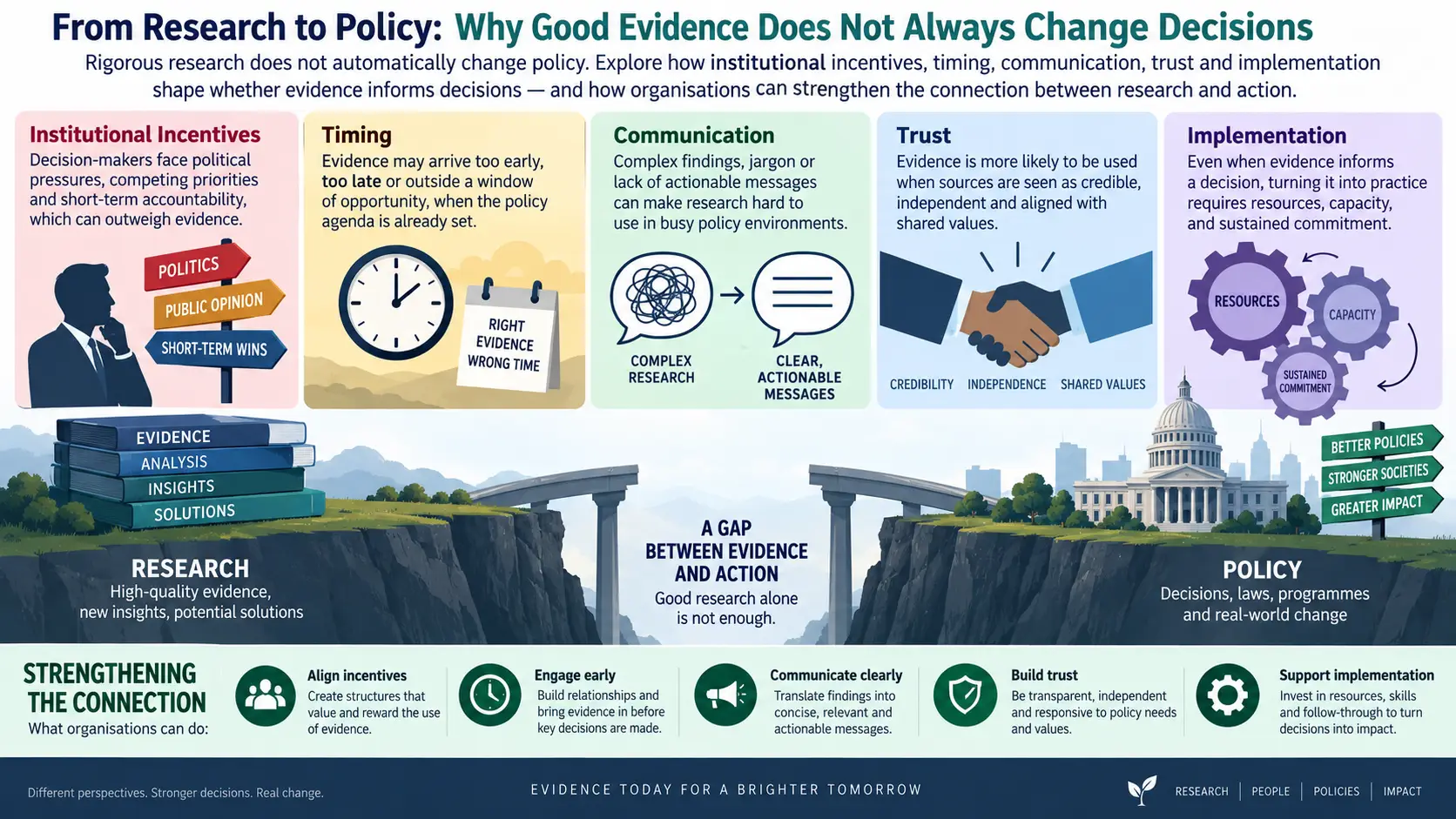
From Research to Policy: Why Good Evidence Does Not Always Change Decisions
Rigorous research does not automatically change policy. Explore how institutional incentives, timing, communication, trust and implementation shape whether evidence informs decisions—and how organisations can strengthen the connection between research and action.
Read MoreThe Cost of Choosing: Using Economic Analysis to Compare Development Options
Development organisations often face several plausible ways to use limited resources. Learn how opportunity cost, cost-effectiveness, equity and uncertainty can help compare alternatives and make better-informed programme and policy decisions.
Read MoreDashboards That Support Decisions: Moving Beyond Attractive Charts
A dashboard can display attractive charts without improving decisions. Learn how to select meaningful indicators, establish data quality, present comparisons in context and connect dashboard insights to practical action.
Read MoreFrom Correlation to Explanation: What Statistical Analysis Can—and Cannot—Tell Us

Statistical relationships can reveal important patterns, but they do not automatically establish cause and effect. Learn how confounding, reverse causality, selection bias and research design influence what statistical analysis can tell us.
Read MoreCredible evidence. Clear thinking. Responsible interpretation.
Our commitment to evidence extends beyond producing findings. It means asking appropriate questions, choosing defensible methods, recognising uncertainty and communicating conclusions in ways that reflect what the evidence can—and cannot—establish.
Methodological rigour
Use methods suited to the question, data and context.
Transparency
Explain relevant assumptions, limitations and uncertainties.
Contextual understanding
Interpret findings in light of institutional, economic, social and policy realities.
Practical relevance
Connect conclusions to the questions and decisions that matter to intended users.
FROM EVIDENCE TO ACTION
Working through a complex question?
Whether you are designing a study, strengthening a monitoring and evaluation system, interpreting data or assessing a policy challenge, DAREL can help you move from uncertainty to evidence-informed action.