
Introduction
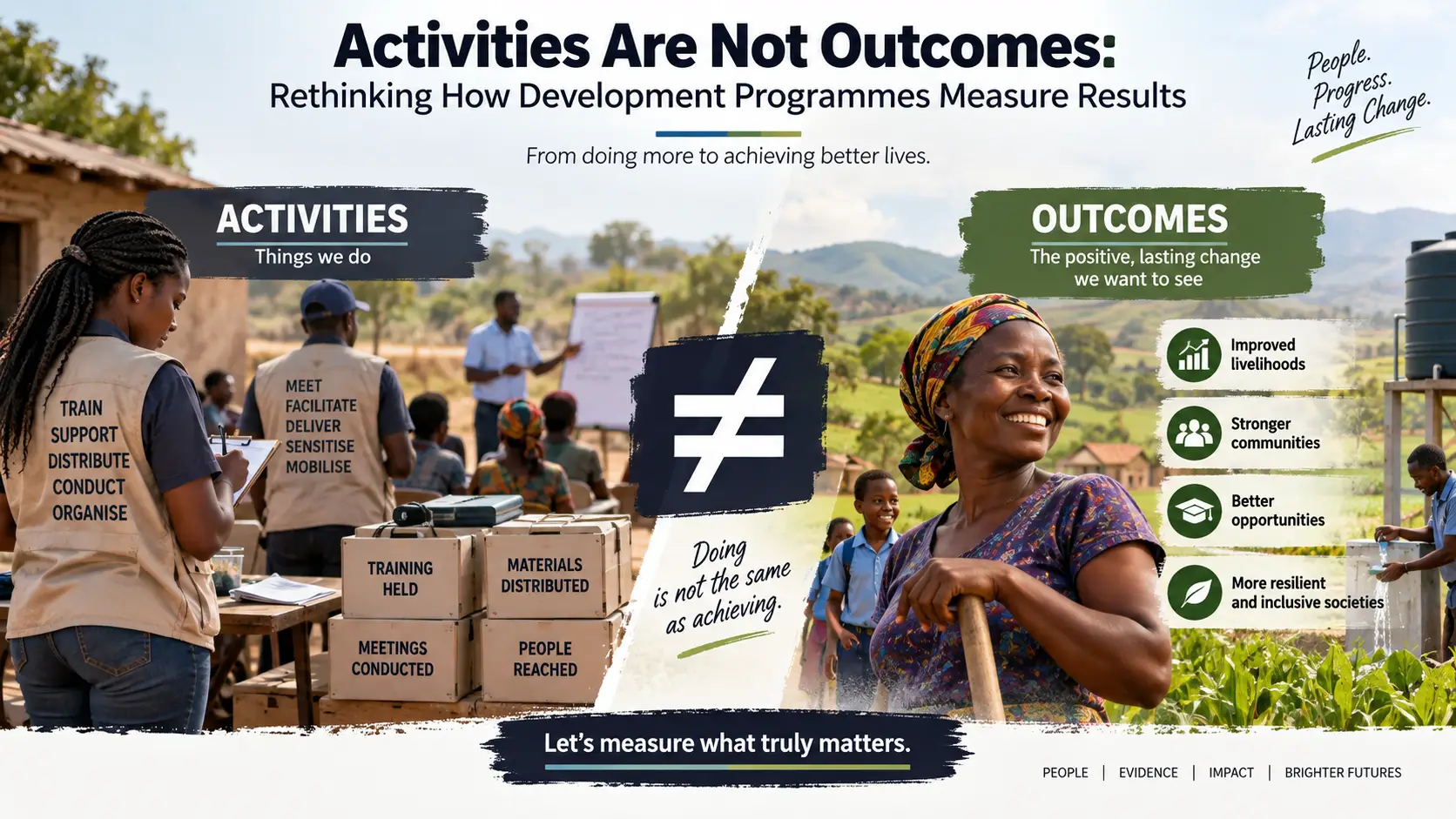
Delivering activities and producing outputs are important, but they do not automatically mean that a development programme has made a meaningful difference. Understanding what changes—and for whom—is central to measuring results.
Development programmes operate under constant pressure to demonstrate results. Donors want accountability for their investments, programme managers need information to guide implementation, and policymakers want to understand whether interventions are improving people’s lives.
In response, organisations develop monitoring frameworks, define indicators, collect data and prepare progress reports. These systems may document the number of people trained, community meetings held, services delivered or materials distributed.
Such information is useful. However, it does not necessarily establish whether the programme has achieved its intended purpose.
A training programme can reach hundreds of participants without improving their skills. An agricultural initiative can distribute improved seeds without increasing productivity. A health programme can conduct outreach activities without improving access to essential services.
The challenge is not simply to measure what a programme does. It is to establish what those activities produce, what changes follow and whether the observed results are consistent with the programme’s objectives.
1. Understanding the difference between activities, outputs, outcomes and impact
A useful starting point is to distinguish the different levels of a programme’s results chain.
Activities are the actions undertaken to implement an intervention. They describe what a programme does.
Outputs are the immediate products or services delivered through those activities. They describe what the programme produces or provides.
Outcomes are the changes in knowledge, behaviour, practices, access, institutional performance or other conditions that follow from an intervention.
Impact refers to broader or longer-term changes to which a programme may contribute. In rigorous evaluation, establishing impact also requires examining whether those changes can credibly be attributed to the intervention.
Consider a programme designed to improve the economic opportunities of young people.
- Activity: Deliver vocational training and business advisory sessions.
- Output: Number of young people trained and completing the programme.
- Outcome: Participants apply their skills, start businesses or obtain employment.
- Impact: Sustained improvements in livelihoods, economic security or broader socioeconomic conditions to which the programme contributes.
Each level answers a different question. Activities indicate implementation effort. Outputs show immediate delivery. Outcomes indicate whether meaningful changes are occurring. Impact concerns the broader significance of those changes and, where relevant, the programme’s contribution or causal effect.
Confusing these levels can lead organisations to overstate their achievements. Reporting that 500 young people completed training demonstrates delivery, but it does not establish that 500 people secured employment or experienced improved livelihoods.
2. Why programmes often focus on activities and outputs
Activity and output indicators are usually easier to define, measure and report than outcomes.
Attendance registers can document participation. Training reports can record sessions delivered. Distribution records can establish how many items were provided. These measures are often available quickly and can be incorporated into routine reporting systems.
Outcome measurement is more demanding.
Determining whether participants apply new skills may require follow-up surveys, workplace observations or interviews. Establishing whether agricultural productivity has improved may require baseline and follow-up measurements, seasonal information and consideration of weather conditions or input costs. Assessing whether a health intervention improves service access may require examining service utilisation, quality, affordability and barriers experienced by different population groups.
There may also be institutional incentives to prioritise easily reported indicators. Funding agreements may emphasise delivery targets, reporting templates may focus on outputs, and implementation teams may face pressure to demonstrate progress within short reporting periods.
These pressures do not make output indicators inappropriate. Outputs are essential for understanding implementation and accountability.
The problem arises when outputs become the primary evidence of success, even when the programme’s objectives concern changes beyond immediate delivery.
A sound monitoring system measures delivery while also examining whether that delivery is leading towards the intended results.
3. Start with the change the programme intends to achieve
Effective results measurement begins with a clear statement of the intended change.
Before selecting indicators, programme teams should ask:
- What problem is the intervention intended to address?
- Who is expected to experience a change?
- What should change, and within what period?
- What conditions must be in place for the change to occur?
- What evidence would demonstrate that the change has happened?
These questions help distinguish programme activities from the results they are intended to produce.
For example, a programme providing agricultural extension services might define its objective as improving smallholder farmers’ productivity and resilience.
Training sessions and farm visits would be activities. The number of farmers reached would be an output. Adoption of appropriate farming practices would be an intermediate outcome. Changes in crop yields, production costs, farm income or resilience to climate-related shocks could represent further outcomes.
However, the relationships between these results should not be assumed.
Farmers may adopt improved practices without experiencing higher incomes if market prices fall, input costs rise or extreme weather damages crops. Conversely, incomes may increase because of favourable market conditions even when the programme has had little influence.
A results framework should therefore explain the logic connecting programme delivery to intended change, including the assumptions and external conditions that may affect progress.
4. Choose indicators that measure meaningful change
Once the intended results are clear, the next step is to identify indicators that provide credible evidence of progress.
An indicator should be linked to a clearly defined result and specify what will be measured, for whom and, where appropriate, over what period.
Consider a youth employment programme with the objective of improving participants’ access to decent work.
| Results level | Example indicator | What it tells us |
|---|---|---|
| Activity | Number of training sessions delivered | Whether planned activities took place |
| Output | Number of participants completing training | Whether the intended service was delivered |
| Intermediate outcome | Proportion of participants applying relevant skills | Whether learning is translating into practice |
| Employment outcome | Proportion of participants employed six months after completion | Whether participants are obtaining employment |
| Longer-term outcome | Change in participants’ earnings or job stability | Whether employment conditions are improving |
The indicators are illustrative. Actual definitions would need to reflect the programme’s objectives, target population, context and available evidence.
Several considerations are important when selecting outcome indicators.
Relevance: Does the indicator measure a result that matters to the programme’s objectives?
Clarity: Can different users interpret the indicator consistently?
Measurability: Can the required information be collected with sufficient reliability?
Disaggregation: Is it necessary to examine differences by sex, age, disability, location or another relevant characteristic?
Timing: Is the expected change likely to occur within the programme’s implementation or evaluation period?
Interpretability: Can the indicator be understood alongside the contextual information needed to make sense of changes?
A large number of indicators does not automatically produce a better monitoring system. A smaller set of well-defined measures, supported by appropriate qualitative and quantitative evidence, may be more useful than an extensive framework that is difficult to maintain and rarely informs decisions.
5. Measure outcomes without assuming causation
One of the most important distinctions in results measurement is the difference between observing change and establishing that a programme caused it.
Suppose the proportion of programme participants in employment rises from 35% at baseline to 55% after training.
This represents a 20-percentage-point increase among the measured participants, assuming the figures are comparable. It does not, by itself, establish that the programme caused the increase.
Employment may have improved because the wider economy expanded, seasonal hiring increased, other organisations introduced complementary interventions or participants obtained employment through opportunities unrelated to the training.
Outcome monitoring can establish whether changes occurred and whether they align with programme objectives. It can also identify patterns that warrant further investigation.
Causal evaluation requires a stronger design capable of estimating what would have happened in the absence of the intervention. Depending on the context, this may involve a comparison group, randomised assignment, a suitable quasi-experimental design or another defensible approach to assessing alternative explanations.
Not every programme requires a complex impact evaluation. The appropriate level of evidence depends on the decision being made, the resources available, the ethical and practical constraints, and the consequences of being wrong.
The essential principle is to ensure that the strength of the conclusions matches the strength of the evidence.
6. Use results measurement to support learning and adaptation
Monitoring should not end when indicators have been calculated and reports submitted.
Its value increases when findings are used to understand implementation challenges, test assumptions and inform decisions.
For example, a programme may report high training completion but low employment outcomes. Rather than responding by increasing the number of training sessions, managers could investigate whether the training matches employer demand, whether participants have access to job-search support, whether transport costs constrain attendance at interviews or whether local labour markets offer sufficient opportunities.
Different findings would imply different responses.
If participants lack practical skills, the programme may need to revise its curriculum. If employers are unaware of graduates’ competencies, stronger employer engagement may be required. If the main constraint is a shortage of jobs, improving training alone may not be sufficient.
This is where monitoring, evaluation and learning become connected.
Monitoring identifies patterns and tracks progress. Evaluation examines performance, mechanisms and, where the design permits, causal effects. Learning processes help teams interpret findings and translate them into action.
A functioning learning system therefore requires more than indicators. It needs clear responsibilities, regular review, credible interpretation, stakeholder feedback and mechanisms for documenting and following up decisions.
7. A practical checklist for reviewing a results framework
Before approving a monitoring framework or reviewing programme performance, ask the following questions:
- Are the intended outcomes explicit? The framework should identify the changes the programme seeks to achieve, not only the activities it plans to deliver.
- Are activities, outputs and outcomes clearly distinguished? Each indicator should correspond to the appropriate level of the results chain.
- Is the logic of change credible? The framework should identify key assumptions, risks and external influences.
- Do the indicators measure what matters? Indicators should reflect meaningful progress towards programme objectives.
- Are data sources and responsibilities clear? Teams should know how information will be collected, verified, analysed and reported.
- Is the timing realistic? Some outcomes may emerge only after implementation or require longer follow-up periods.
- Are findings used to inform decisions? Review processes should identify what is working, what is not and what needs to change.
- Do conclusions reflect the available evidence? Reports should distinguish documented delivery, observed change and demonstrated causal effects.
A framework that addresses these questions is more likely to support both accountability and improvement.
Conclusion: Measure what changes, not only what is delivered
Activities and outputs remain essential components of programme monitoring. They establish whether implementation is taking place and whether intended services are reaching the people for whom they were designed.
However, delivery is not the same as success.
Understanding programme performance requires examining whether activities produce the expected outputs, whether those outputs contribute to meaningful outcomes and whether the available evidence supports the conclusions being drawn.
For development organisations, this means designing results frameworks around intended change, selecting indicators that answer relevant questions and creating processes through which findings inform decisions.
The objective is not to measure everything. It is to generate credible, useful evidence about whether a programme is making a difference, for whom, under what conditions and with what implications for future action.
At DAREL Consulting, we connect monitoring, evaluation, data analytics and learning to help organisations move beyond reporting what they deliver towards understanding the results they achieve. Because meaningful accountability begins not with the number of activities completed, but with the changes those activities are intended to make possible.