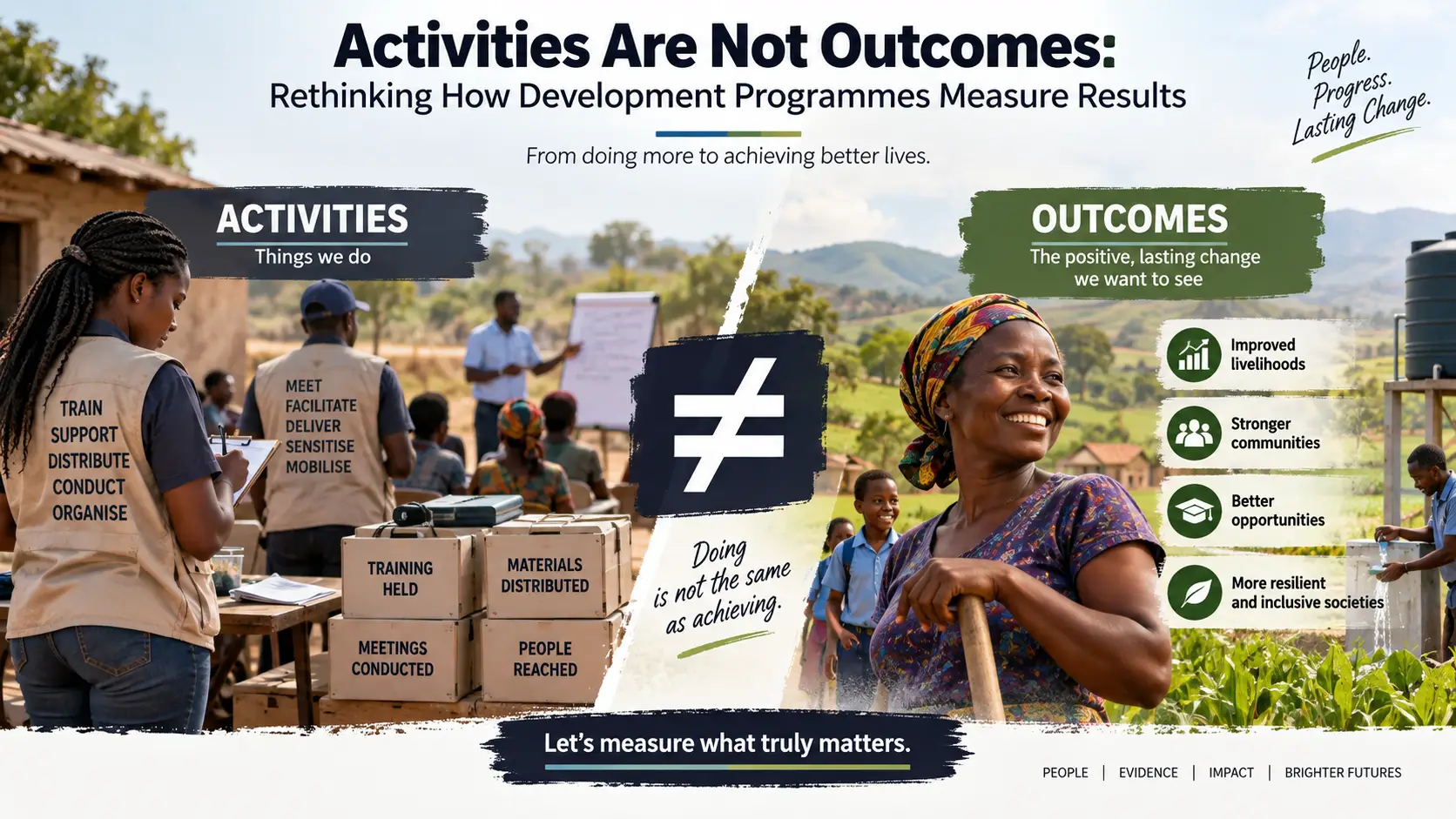
A programme can spend its budget, deliver its planned activities and meet its output targets without demonstrating that it has used resources well. Assessing value for money requires a closer look at costs, efficiency, results and who benefits.
Development programmes operate under resource constraints. Governments, foundations, donors and implementing organisations must decide how to allocate limited funds across competing priorities. They must also demonstrate that the resources entrusted to them are being used responsibly and contributing to meaningful results.
Financial reports can show how much money was spent. Activity reports can show what was delivered. Performance indicators can show whether targets were met. Yet these forms of accountability do not necessarily establish whether a programme represents good value for money.
A programme may deliver services at a high cost when a less expensive approach could achieve similar results. Another may operate efficiently but fail to achieve its intended outcomes. A third may demonstrate strong average results while leaving the people facing the greatest barriers behind.
These possibilities illustrate why value for money requires more than a comparison between budgeted and actual expenditure.
Value for money is about understanding the relationship between the resources invested, the services delivered, the results achieved and the distribution of those results.
A sound assessment brings financial, operational and outcome evidence together to inform decisions about programme design, resource allocation and implementation.
1. What does value for money mean?
Value for money is commonly examined through four connected dimensions: economy, efficiency, effectiveness and equity.
Each dimension addresses a different question.
Economy asks whether the resources needed for implementation were acquired at an appropriate cost and quality.
Efficiency examines the relationship between resources used and outputs or services delivered.
Effectiveness considers whether the intervention achieved its intended objectives and outcomes.
Equity examines how costs, services and benefits are distributed across different groups, including whether people facing greater barriers can access and benefit from the intervention.
These dimensions should be considered together. Strong performance in one does not automatically establish good value for money overall.
For example, an organisation may purchase materials at low prices, demonstrating economy, but experience delays or poor quality that reduce the effectiveness of implementation. A programme may deliver many services at low unit cost but fail to produce meaningful improvements in participants’ lives.
Similarly, an intervention may achieve strong average outcomes while disproportionately benefiting people who were already better positioned to succeed.
Value for money therefore requires a balanced assessment rather than a single financial ratio or performance indicator.
2. Economy: Are resources being acquired appropriately?
Economy concerns the cost of obtaining the resources required to deliver a programme.
These resources may include staff, equipment, materials, transport, facilities, technology and contracted services.
An economy assessment considers whether procurement and other resource acquisition decisions achieve appropriate quality at a reasonable cost.
For example, a programme purchasing equipment may compare supplier prices, delivery terms, expected durability, maintenance requirements and compatibility with existing systems. The cheapest option may not represent the best decision if it fails frequently or requires expensive repairs.
Similarly, lower staffing costs may appear attractive but could undermine implementation if the programme lacks the expertise needed to deliver services safely and effectively.
Useful questions include:
- Were purchases consistent with the programme’s requirements?
- Were procurement decisions competitive and transparent where required?
- Were appropriate quality standards maintained?
- Were avoidable costs, delays or unnecessary purchases identified?
- Were whole-life costs considered where relevant?
An economy assessment should not assume that lower expenditure is always better. The objective is to acquire suitable resources at an appropriate cost without compromising essential quality, compliance or delivery requirements.
3. Efficiency: Are resources being converted into outputs effectively?
Efficiency examines the relationship between resources consumed and outputs produced.
A programme may have sufficient funding and a sound design but still incur unnecessarily high costs, experience delays or deliver fewer services than expected.
One common approach is to examine the cost per unit of output.
Consider a hypothetical programme that spends KSh 6 million to deliver 1,200 training places. Its expenditure per training place is:
[
\frac{\text{KSh }6,000,000}{1,200}
=\text{KSh }5,000
]
This calculation provides a useful starting point. However, it does not establish whether the programme is efficient.
The assessment needs to consider what the cost includes, whether the training places were actually delivered, whether quality was maintained and whether the output definition is comparable with those used elsewhere.
A programme delivering fewer but more intensive training sessions may have a higher cost per participant while providing greater support. Another may achieve a lower unit cost by delivering sessions that participants cannot easily apply.
Efficiency analysis should therefore examine both the quantity and quality of outputs.
Other useful measures may include:
- Cost per household reached.
- Cost per service delivered.
- Staff time required per case processed.
- Cost per completed assessment.
- Administrative expenditure relative to total programme expenditure.
Comparisons can reveal opportunities for improvement, but they must account for differences in context, service intensity, target populations and delivery models.
A programme serving remote communities, for example, may reasonably incur higher transport costs than one operating in a densely populated urban area.
The central question is not simply whether a programme has a low unit cost. It is whether it converts resources into appropriate outputs without avoidable waste or unnecessary reductions in quality.
4. Effectiveness: Are the intended results being achieved?
Efficiency focuses on the relationship between resources and outputs. Effectiveness shifts attention to the changes those outputs are intended to produce.
A programme can deliver every planned activity without achieving its intended outcomes.
A health programme might conduct all scheduled outreach sessions but fail to improve access to essential services. An agricultural programme might distribute inputs on time without improving productivity or household income. A business development programme might train participants without improving enterprise performance.
These examples demonstrate why output targets cannot substitute for outcome evidence.
An effectiveness assessment begins by clarifying the programme’s objectives and identifying appropriate indicators of progress. It then examines whether the expected changes occurred, for whom and over what period.
Depending on the intervention, evidence may include changes in knowledge, behaviour, service access, institutional performance, income, productivity or other relevant outcomes.
The analysis should also consider alternative explanations. Observing improvement among participants does not automatically establish that the programme caused it. External economic conditions, other interventions or differences between participants and non-participants may also influence the results.
Where the question concerns causal impact, an appropriate evaluation design may be required.
Effectiveness also helps interpret efficiency. A low cost per output is less meaningful if those outputs do not contribute to the intended results.
Ultimately, programmes should not be judged solely by how much they deliver, but also by whether their delivery achieves the changes that justify the investment.
5. Equity: Who benefits, and who may be left behind?
Aggregate results can conceal important differences in access and outcomes.
A programme may report that most participants benefited, while certain locations or population groups experience lower participation, poorer service quality or weaker outcomes.
Equity analysis examines these differences and considers whether resources and benefits are distributed in ways that reflect needs, barriers and programme objectives.
For example, two service delivery models may achieve similar average outcomes but differ in their reach. One may primarily serve people who can easily travel to programme facilities, while another invests in outreach to remote communities.
The second model may incur higher costs per participant but reach people who would otherwise remain underserved.
Whether the additional cost is justified depends on the programme’s objectives, the benefits achieved and the importance of improving equitable access.
Useful questions include:
- Who receives the services?
- Who completes the programme?
- Which groups experience the intended outcomes?
- Are there meaningful differences across gender, age, disability, location or socioeconomic circumstances?
- Are the groups facing the greatest barriers adequately served?
- What additional resources are required to reach them effectively?
Disaggregation and qualitative investigation can help identify these differences.
Equity does not mean that every programme must deliver identical services at identical costs to every group. It means making distributional consequences visible and assessing them against the intervention’s objectives and the needs of its intended population.
6. Bring financial and performance data together
Value-for-money assessments become more useful when financial information is linked to programme implementation and results.
Financial systems may record expenditure by budget line, department or funding source. Monitoring systems may track activities, participants, outputs and outcomes. Evaluation studies may examine effectiveness and explain why results differ.
When these sources are analysed separately, organisations can struggle to establish how expenditure relates to performance.
Connecting them requires clear definitions, consistent reporting periods and appropriate links between financial and programme records.
For example, a programme might compare expenditure across locations with the number of services delivered, the quality of those services and the outcomes achieved. If one location incurs higher costs, the difference could reflect inefficiency, more difficult operating conditions, more intensive support or better results.
The figures alone will not explain which interpretation is correct. Additional analysis and contextual evidence may be necessary.
Organisations should also establish which costs are included. Staff time, overheads, shared services, capital expenditure and in-kind contributions can affect comparisons. Omitting relevant costs may produce misleading unit-cost estimates.
Where programme costs are compared with outcomes, analysts should ensure that the costs and outcomes cover compatible periods and populations.
The objective is to create a coherent picture of resource use and performance rather than simply placing expenditure and indicator tables side by side.
7. Choose methods that match the decision
Not every value-for-money question requires a full economic evaluation.
The appropriate method depends on the decision, the available evidence and the consequences of getting the decision wrong.
Cost analysis examines the resources consumed by a programme and can help establish the cost of delivery.
Cost-efficiency analysis compares the resources used to produce defined outputs.
Cost-effectiveness analysis compares the costs of alternatives against a common outcome measure, such as the cost per additional person receiving an effective service.
Cost-benefit analysis expresses relevant costs and benefits in monetary terms to assess whether the expected benefits justify the investment, subject to assumptions and valuation challenges.
These methods answer different questions and should not be treated as interchangeable.
For example, cost-effectiveness analysis may help compare two approaches that achieve the same type of outcome. Cost-benefit analysis may support a broader comparison when important benefits and costs can reasonably be valued in monetary terms.
In practice, the available evidence may not support a sophisticated economic evaluation. A programme may lack reliable cost records, consistent outcome measures or a credible comparison of alternatives.
In such cases, organisations can begin with transparent cost analysis, improve their data systems and identify what additional evidence is needed.
The method should follow the decision question, not the other way around.
8. Interpret findings in context
Value-for-money results can appear precise while depending on important assumptions.
Unit costs may change because of differences in participant numbers, service intensity, geographic conditions, staff experience or the inclusion of overheads. Outcome comparisons may be affected by differences in baseline conditions or the period over which results are measured.
A robust assessment should therefore make its assumptions explicit, test the sensitivity of important results where feasible and communicate uncertainty.
It should also distinguish between findings that are established by the evidence and conclusions that remain tentative.
For example, a higher cost per participant may indicate inefficient delivery, but it may also reflect deliberate investment in more intensive support. Determining which explanation is more plausible requires evidence about programme design, implementation quality and outcomes.
Contextual interpretation prevents organisations from treating every cost difference as waste or every positive outcome as proof of good value.
It also supports better decisions about whether to maintain an intervention, change its design, improve implementation, expand it or investigate alternatives.
A practical checklist for assessing value for money
Before drawing conclusions about a programme’s value for money, ask:
- Are the programme objectives and intended outcomes clearly defined?
- Are the relevant costs identified and consistently measured?
- Were resources acquired at an appropriate cost and quality?
- Are outputs being delivered without avoidable waste?
- Is there evidence that outputs contribute to intended outcomes?
- Are costs and results comparable across locations, groups or delivery models?
- Are the distribution of benefits and barriers to access examined?
- Are the assumptions and limitations of the analysis transparent?
- Is the analytical method appropriate for the decision?
- Will the findings inform a specific resource allocation or programme improvement decision?
A value-for-money assessment should ultimately help decision-makers understand not only what resources were spent, but also what those resources achieved and whether another approach could produce better results.
Conclusion: Value for money is about results, not just expenditure
Responsible financial management is essential, but expenditure control alone cannot establish whether a programme represents good value for money.
A meaningful assessment connects economy, efficiency, effectiveness and equity. It examines whether resources were acquired appropriately, whether they were converted into quality outputs, whether those outputs contributed to intended results and whether the benefits reached the people the programme was designed to serve.
The strongest assessments combine financial records with monitoring data, evaluation findings and contextual evidence. They also make uncertainty and limitations explicit rather than relying on a single ratio to represent programme performance.
For programme leaders and funders, the ultimate purpose is practical: to make better-informed decisions about where resources should go, how interventions should be delivered and which approaches deserve continued investment.
At DAREL Consulting, we connect research, evaluation, data analytics and economics to help organisations understand programme performance, assess resource use and translate evidence into more informed decisions.
Good value for money is not simply spending less. It is using resources wisely to achieve meaningful, effective and equitable results.