Collecting indicators and producing reports can show what a programme has done. But unless the evidence informs decisions, challenges assumptions and guides adaptation, monitoring may become a reporting exercise rather than a tool for improvement.
Many organisations invest considerable effort in developing monitoring frameworks. They define indicators, establish targets, assign responsibilities, create reporting templates and collect data throughout implementation.
These are important elements of programme management. Yet a familiar problem remains: reports are produced, meetings are held, and indicators are updated, but the evidence does not consistently influence what happens next.
A programme may report that it trained 500 people, reached 20 communities or distributed 1,000 items. The figures may be accurate, but managers may still lack answers to more important questions. Are the intended participants benefiting? Which implementation challenges are emerging? Why are some activities performing better than others? What should change?
The distinction is between having a monitoring framework and operating a learning system.
A monitoring framework organises the collection and use of information about programme performance. A learning system connects that information to interpretation, decisions, action and subsequent review.
For organisations seeking to improve programme effectiveness, the goal should not be to collect more data simply because it is possible. It should be to generate and use the evidence needed to manage uncertainty, improve implementation and achieve meaningful results.
1. Understand the difference between monitoring and learning
Monitoring and learning are closely related, but they serve different purposes.
Monitoring systematically tracks implementation, performance and changes over time. It helps organisations understand whether activities are taking place as planned, whether targets are being met and where performance differs from expectations.
Learning involves interpreting information, examining why results are occurring, testing assumptions and using what is discovered to improve decisions.
Consider a livelihoods programme that monitors the number of participants receiving business training.
The monitoring framework might show that 90% of the planned participants completed training. This is useful information about delivery.
A learning-oriented approach asks additional questions. Are participants applying the skills? What prevents some participants from using them? Do outcomes differ by gender, location or type of enterprise? Are the services addressing the constraints participants actually face?
The answers may reveal that attendance is high but practical application is limited because participants lack access to finance, markets or suitable equipment.
The appropriate response may therefore involve more than delivering additional training. The programme might need to strengthen referrals, adapt advisory services or reconsider whether its original intervention adequately addresses the barriers participants face.
Monitoring identifies patterns in performance. Learning helps explain those patterns and determine what to do about them.
2. Start with decisions, not indicators
A common weakness in monitoring systems is the accumulation of indicators without a clear understanding of how the information will be used.
Indicators may be inherited from donor templates, strategic plans or existing reporting systems. Some are necessary for accountability, but others may be collected without a clear decision attached to them.
An indicator is most useful when it helps answer a relevant management or strategic question.
For example, an organisation managing a healthcare access programme may track the number of community outreach sessions conducted. That indicator can help managers assess implementation, but it may not tell them whether people who previously lacked access to services are now receiving care.
A decision-oriented framework starts by identifying the questions that managers and other stakeholders need to answer.
These might include:
- Are planned activities reaching the intended populations?
- Are services being delivered at the expected quality?
- Are participants experiencing the intended changes?
- Which groups are benefiting less than others?
- What is preventing progress towards expected results?
- Where should resources or implementation approaches be adjusted?
The indicators, data sources and review processes can then be selected to answer these questions.
This approach helps reduce unnecessary reporting and gives each indicator a clearer purpose. It also reveals where routine monitoring data are insufficient and additional evaluation or research may be required.
3. Connect indicators to a clear results logic
A monitoring framework should reflect how a programme expects its activities to contribute to results.
A typical results chain distinguishes between inputs, activities, outputs, outcomes and longer-term impacts.
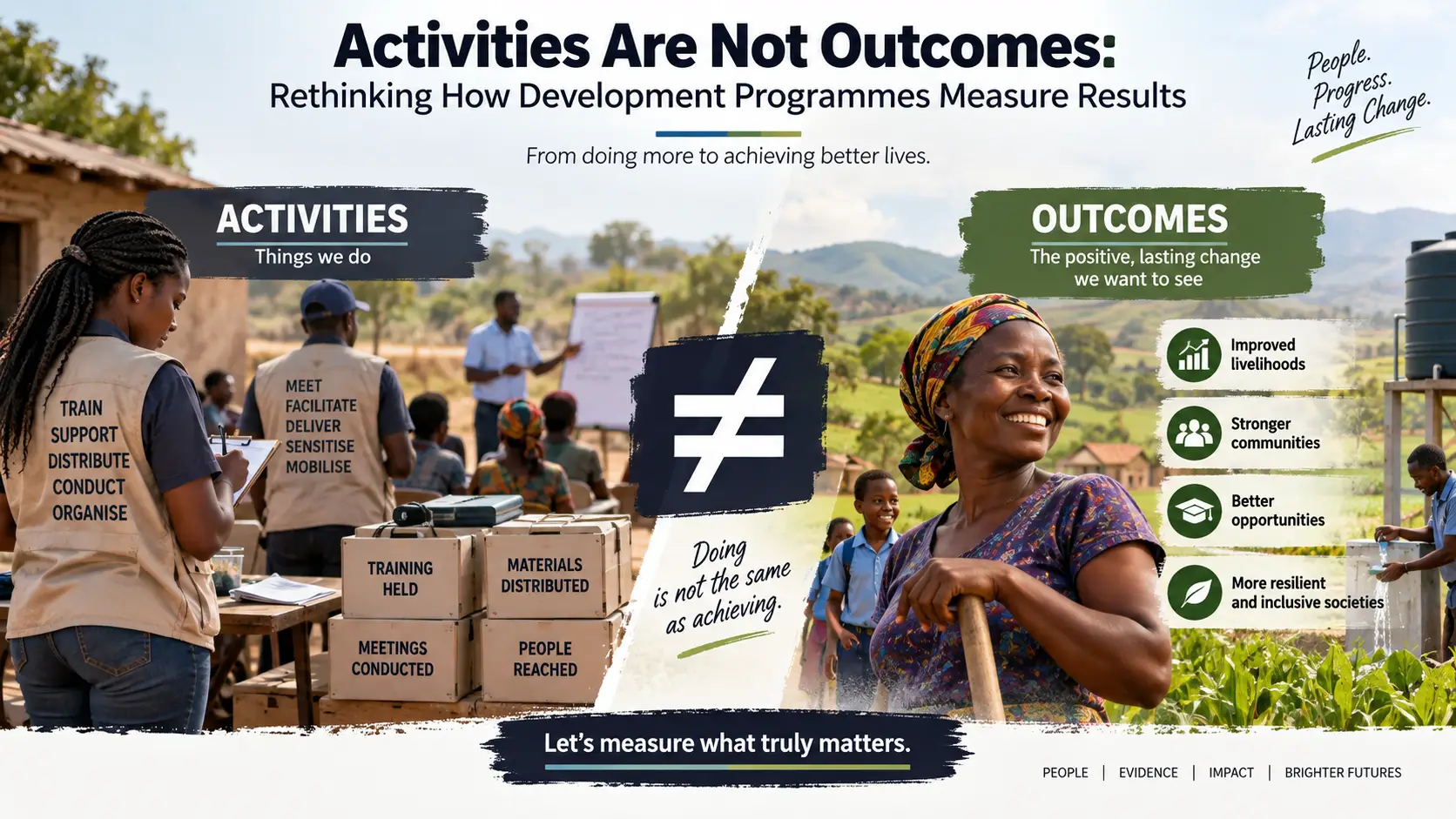
Inputs are the resources invested. Activities are what the programme does. Outputs are the immediate products or services delivered. Outcomes are the changes experienced by people, institutions or systems. Impacts refer to broader, longer-term changes to which a programme may contribute.
These distinctions matter because progress at one level does not automatically establish progress at another.
A programme can deliver every planned training session without demonstrating that participants acquired the intended skills. Participants may acquire skills without applying them. Even when they apply them, external factors may influence whether their livelihoods improve.
A useful monitoring system therefore tracks more than delivery. It includes appropriate measures of the changes the programme intends to achieve and the assumptions connecting one stage of the results chain to the next.
For example, if a programme expects financial literacy training to improve enterprise performance, it should examine whether participants acquire relevant knowledge, apply it in business decisions and experience changes in appropriate performance measures.
The purpose is not to measure everything. It is to identify the evidence needed to assess whether the programme’s logic is holding and where it may need reconsideration.
4. Build regular opportunities to interpret evidence
Data do not interpret themselves.
A dashboard may reveal that one location is below target, that costs are increasing or that participation has declined. These patterns are signals for investigation, not explanations in themselves.
Organisations need regular, structured opportunities to examine what the data mean.
These discussions should bring together people who understand different parts of implementation. Monitoring staff may identify patterns in the data, programme teams may explain operational realities, and community representatives or frontline workers may identify experiences that are not visible in routine indicators.
Effective review meetings go beyond reading out figures.
They examine:
- What has changed since the previous review?
- Which results are on track, and which are not?
- What explains important differences or unexpected findings?
- Are the data sufficiently reliable to support the proposed interpretation?
- Which assumptions need to be tested?
- What decisions or actions are required?
The quality of these discussions depends on preparation. Participants should receive concise summaries of the most important findings, questions and exceptions before meetings take place.
A meeting focused on a small number of consequential issues is often more useful than one that attempts to discuss every indicator.
5. Investigate why performance differs
When performance falls below expectations, organisations may be tempted to respond immediately with corrective action.
Sometimes this is appropriate. But acting without understanding the cause can address symptoms while leaving the underlying problem unresolved.
Suppose a programme finds that participation among women is lower than expected. The initial indicator identifies a difference, but it does not explain it.
Possible explanations might include inconvenient session times, transport costs, childcare responsibilities, safety concerns, communication gaps or programme activities that do not match participants’ priorities.
Each explanation implies a different response.
Researchers and programme teams can investigate through disaggregated monitoring data, participant feedback, interviews, focus group discussions, administrative records or targeted studies. The method should fit the question and the decision at stake.
Teams should also examine whether the apparent problem reflects actual performance or weaknesses in data collection. Inconsistent reporting, missing records or changes in indicator definitions can create patterns that do not represent real changes.
The aim is to move from identifying a performance gap to developing a credible explanation for it.
Where evidence remains incomplete, the organisation should acknowledge uncertainty and consider a proportionate way to investigate further.
6. Turn findings into documented decisions and action
A learning meeting has limited value if the discussion does not influence implementation.
Every significant review should establish what will happen next, who is responsible and when progress will be revisited.
For example, a review may identify that participants are not applying newly acquired skills because follow-up support is insufficient. The programme could agree to test a revised support model in selected locations, assign responsibility to the implementation team and monitor whether the changes improve application.
The action should be specific enough to implement and assess.
A practical action log might record:
- Finding: The evidence or implementation issue identified.
- Interpretation: The current explanation and any remaining uncertainty.
- Decision: What the team has agreed to change, maintain or investigate.
- Responsibility: Who will take the action.
- Timeline: When it should be completed or reviewed.
- Follow-up evidence: How the team will assess whether the response helped.
Documenting decisions creates organisational memory. It also makes it possible to revisit earlier assumptions and determine whether actions produced the expected results.
Not every finding should trigger a programme change. Some may confirm that the current approach is working; others may require further investigation. The important point is that decisions should be deliberate and traceable to evidence.
7. Create a culture where evidence can challenge assumptions
A functioning learning system depends on more than procedures and templates. It also depends on organisational culture.
If staff expect negative findings to be punished, they may be reluctant to report implementation problems. If managers only reward progress against targets, teams may focus on presenting favourable figures rather than understanding why performance differs from expectations.
A learning-oriented culture does not eliminate accountability. It strengthens accountability by encouraging accurate reporting, honest interpretation and timely responses to problems.
Managers can support this culture by asking constructive questions, distinguishing between reasonable experimentation and avoidable negligence, and making space for evidence that challenges existing plans.
Community feedback and frontline experience should also be treated as potential sources of learning rather than as information to be collected only for compliance.
At the same time, organisations should avoid treating every anecdote as conclusive evidence. Experiences and qualitative findings need to be interpreted carefully and, where appropriate, considered alongside quantitative and administrative data.
The objective is to create an environment where evidence is taken seriously, uncertainty can be discussed openly and decisions remain open to revision when new information emerges.
8. Match the learning system to the programme
Not every programme requires a complex monitoring platform, a large indicator set or frequent evaluation studies.
The appropriate system depends on the programme’s scale, complexity, risks, duration and decision requirements.
A small project may need a short set of indicators, regular participant feedback and a monthly review of implementation challenges. A multi-country programme may require harmonised definitions, disaggregated reporting, data quality assurance, cross-country learning and formal evaluation.
What matters is whether the system provides credible and timely information for the decisions that must be made.
Organisations should also distinguish between routine monitoring and evaluation. Monitoring provides ongoing information about implementation and results. Evaluation investigates the merit, effectiveness or broader effects of an intervention in greater depth, using methods suited to the evaluation questions.
Monitoring can flag an unexpected result, but it may not establish why the result occurred or whether the programme caused it. Evaluation or additional research may be needed to answer those questions.
A strong system uses these functions together without expecting one to replace the other.
A practical checklist for connecting monitoring to learning
Organisations can assess their current approach by asking:
- Are indicators linked to clear programme objectives and intended results?
- Does each important indicator serve a defined management, accountability or learning purpose?
- Are outcomes measured alongside activities and outputs?
- Are data quality limitations identified before findings are interpreted?
- Are monitoring results reviewed regularly by people who can act on them?
- Do review meetings investigate explanations rather than simply report performance?
- Are participant feedback and frontline experiences incorporated into analysis?
- Are decisions, responsibilities and follow-up actions documented?
- Is there a process for checking whether agreed actions improve performance?
- Can the programme revise its assumptions and approach when evidence warrants it?
If a system collects extensive data but cannot answer these questions, the challenge may not be a lack of indicators. It may be a weak connection between measurement, interpretation and action.
Conclusion: The value of monitoring lies in how evidence is used
A monitoring framework provides structure for measuring programme performance. A learning system makes that information useful by connecting it to investigation, reflection, decisions and adaptation.
The transition does not necessarily require more data, more reporting or more sophisticated technology. It requires clarity about the questions that matter, credible evidence, meaningful opportunities to interpret findings and a disciplined process for acting on what is learned.
For programme leaders, the central question is not simply whether monitoring reports are being produced. It is whether those reports are helping the organisation make better decisions and improve the results it achieves.
At DAREL Consulting, we connect monitoring and evaluation, research, data analytics and evidence-informed decision-making to help organisations move beyond reporting towards meaningful programme learning.
A monitoring system tells you what is happening. A learning system helps you understand why it matters, what to do next and whether that decision made a difference.